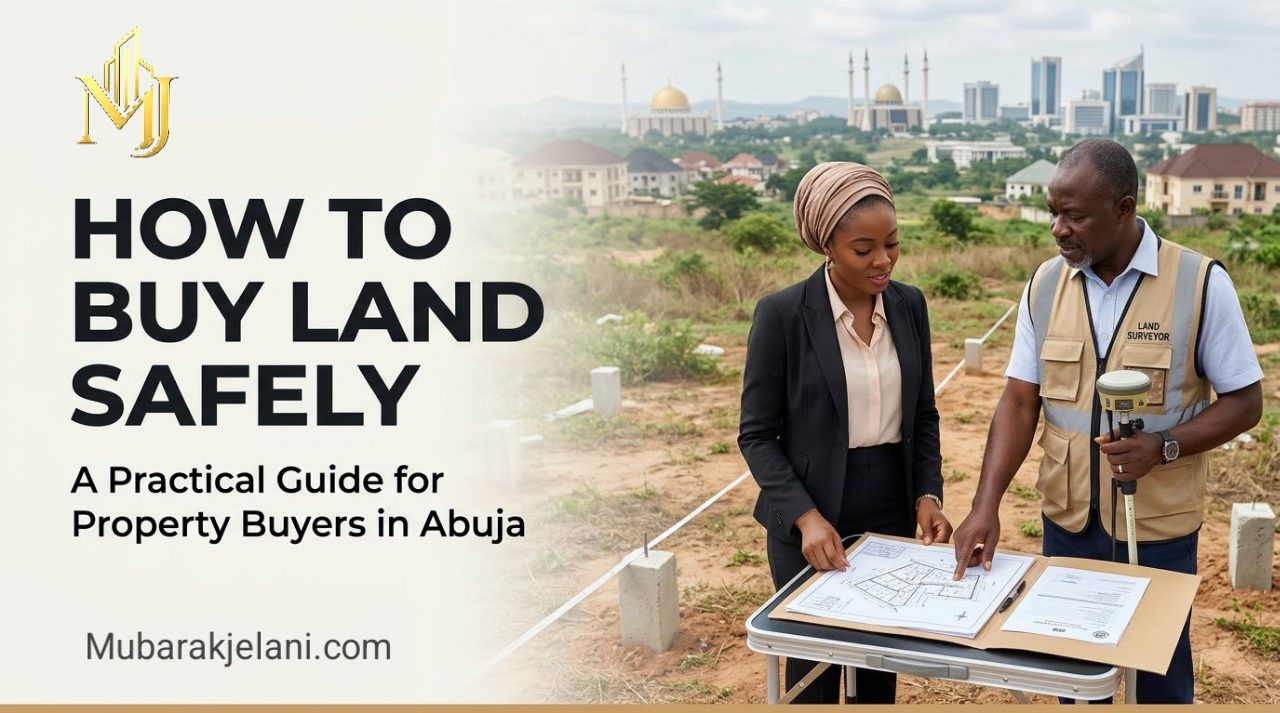
How to Buy Land Safely in Abuja: 14 Things to Check
How to Buy Land Safely in Abuja: A Complete Guide for First-Time Buyers
Buying land in Abuja can be a good investment. However, it can also become a costly mistake if you buy from the wrong person or fail to check the land properly.
Every day, people buy land in Abuja with the hope of building a house, starting a business or keeping the land for future investment. Unfortunately, some buyers lose their money because they did not check the land documents, investigate the seller or confirm whether the government has approved the land for development.
Some people even discover that the land they paid for belongs to another person.
This is why you should never rush into buying land simply because the price is attractive or the agent promises that the land will increase in value.
If you are planning to buy land in Abuja, this guide will explain everything you need to know, from finding the right property to checking land documents, verifying ownership and completing the purchase.
The goal is simple: Help you understand what to check before paying for land in Abuja.
1. Understand the Location Before Buying Land
The first thing to consider when buying land in Abuja is the location.
Abuja has many developing areas where people buy land for residential, commercial and investment purposes.
Some popular locations include:
- Lugbe
- Kuje
- Kubwa
- Karsana
- Katampe Extension
- Apo
- Gwagwalada
- Idu
- Kurudu
- Jikwoyi
- Zuba
- Life Camp
- Lokogoma
However, not every location is suitable for every buyer.
For example, someone who wants to build a house and move in immediately may prefer an area with good roads, electricity, water and access to the city.
On the other hand, someone buying land for long-term investment may consider a developing area where land is more affordable.
Before choosing a location, ask yourself these questions:
- Is the area accessible?
- Are there good roads leading to the land?
- Is electricity available?
- Are people already living in the area?
- Are there schools, hospitals and markets nearby?
- Is the area approved for the type of development I want?
- Is the land affected by government acquisition or planning restrictions?
Do not buy land simply because someone tells you that the area will become the next big thing in Abuja.
Visit the location and study what is actually happening there.
2. Confirm That the Land Is Approved for Development
One important thing to understand about Abuja is that not every available piece of land is suitable for private development.
Some land may fall within government acquisition areas, road reservations, green areas, public infrastructure corridors or other restricted zones.
For example, someone may offer you affordable land close to a major road. However, that land could fall within a government road expansion corridor.
If you buy without checking, you may later discover that the land cannot be used for your intended purpose.
Before buying, find out:
- Whether the land is within an approved layout.
- Whether the land is under government acquisition.
- Whether the proposed use is permitted.
- Whether there are planning restrictions.
- Whether the plot has been properly allocated.
In Abuja, the Abuja Geographic Information Systems (AGIS) and the relevant FCT land administration authorities are important places to begin your verification.
Never depend only on what a land agent or seller tells you.
3. Verify the Land Documents Before Making Payment
This is one of the most important steps when buying land in Abuja.
A seller may show you several documents and tell you that the land is fully approved. However, you must confirm that the documents are genuine and relate to the exact land being sold.
Here are some common land documents you may encounter in Abuja.
A. Certificate of Occupancy (C of O)
A Certificate of Occupancy is an official government document that provides evidence of a statutory right of occupancy over a particular piece of land.
It contains important information such as:
- Name of the holder.
- Location of the land.
- Plot details.
- Size of the land.
- Conditions attached to the grant.
However, having a C of O does not automatically mean that the land has no ownership dispute or other legal problem.
You still need to investigate the land and its ownership history.
B. Right of Occupancy (R of O)
A Right of Occupancy is the legal right to occupy and use a particular piece of land.
In Abuja, you may encounter an Offer of Statutory Right of Occupancy or an issued Right of Occupancy document.
Do not confuse an offer letter with a completed grant or an issued Certificate of Occupancy.
An offer usually contains conditions that the recipient must fulfil before the process is completed.
C. Deed of Assignment
A Deed of Assignment is a legal document used to transfer an interest in land from one person to another.
For example, Mr Musa owns a plot of land and decides to sell it to Mr Ibrahim.
After agreeing on the transaction, a Deed of Assignment can be prepared to document the transfer of the relevant interest.
The document should correctly identify the seller, buyer and land.
It should also be properly executed and registered where required.
D. Survey Plan
A Survey Plan shows the exact location, boundaries, dimensions and other technical details of a piece of land.
It is prepared by a registered land surveyor.
A survey plan helps you identify the land and check whether it falls within an approved layout or an area affected by government acquisition.
Do not accept a survey plan without checking whether it matches the actual land you are buying.
E. Allocation Letter
An Allocation Letter is a document showing that a government authority or another legitimate landowner has allocated a particular plot to someone.
If a developer shows you an allocation letter, do not assume that the developer automatically has the right to sell every plot in the layout.
Investigate the original allocation, the developer’s authority and any required approvals for subdivision or transfer.
Important: No single document should be accepted as proof that a land transaction is completely safe. The documents must be checked together with the ownership history and the actual land.
4. Conduct an Official Land Search at AGIS
If you are buying land in Abuja, one of the most important things you should do is conduct an official land search.
AGIS means Abuja Geographic Information Systems.
It is an FCT government agency responsible for important land records, geospatial information and land title services.
AGIS provides services that help people investigate land ownership, title status and other registered information.
A land search helps you find out whether the land records match the documents presented by the seller.
What Can You Discover Through a Land Search?
Depending on the available records, a search can help you investigate:
- The registered holder of the land.
- The title status.
- Whether the land has existing registered interests.
- Whether there are recorded restrictions or other issues.
- Whether the land details match the official records.
How to Conduct a Land Search in Abuja
Generally, you should:
- Obtain copies of the seller’s land documents.
- Identify the land’s plot number, file number and location.
- Prepare an application for an official title search.
- Follow AGIS requirements and payment procedures.
- Present the original title document for sighting where required.
- Submit your application and obtain the search result.
Visit the official AGIS website for current requirements and procedures.
Website: https://agis.fcta.gov.ng/
Important: Do not allow the seller or agent to be the only person responsible for verifying the documents. Make your own independent enquiries.
5. Visit the Land Physically Before Paying
Never buy land in Abuja without visiting the actual location.
Some people buy land based on pictures, videos and WhatsApp messages. This is risky because the land shown in the pictures may not be the same land being sold.
During your inspection, check the following:
1. Confirm the exact location.
Make sure the land is in the location advertised by the seller.
2. Check the boundaries.
Ask the surveyor to identify the plot boundaries and confirm the measurements.
3. Look for boundary beacons.
Beacons are markers used to identify the boundaries of a surveyed plot.
4. Check the road access.
Find out whether there is an existing access road or only a proposed road.
5. Observe the surrounding development.
Look at nearby houses, estates, roads, electricity and other infrastructure.
6. Speak with people around the area.
Where appropriate, speak with neighbours or community members to understand the history of the land and whether there have been disputes.
7. Compare the land with the survey plan.
Do not assume that the plot you are standing on is the same plot described in the documents.
A registered surveyor should help you confirm this.
6. Find Out Who Actually Owns the Land
One common problem in land transactions is dealing with someone who does not have the legal authority to sell the land.
For example, a person may advertise land that belongs to a family or another individual.
Sometimes, a family member sells land without the necessary authority or consent from other people who have an interest in it.
Before buying, establish who owns the land and who has the legal right to sell it.
If the land belongs to a family, investigate the family ownership structure and confirm that the people executing the sale have the necessary authority.
If you are buying from a company or estate developer, check:
- The company’s identity and registration.
- Its legal interest in the land.
- Its authority to sell the plots.
- The documents supporting its ownership.
- Any required government approvals.
Do not pay someone simply because they have a company office, business card or attractive property brochure.
7. Hire a Property Lawyer and Registered Surveyor
Some buyers try to avoid professional fees because they want to save money.
This can be a costly mistake.
A property lawyer and a registered surveyor perform different but important jobs.
What Does a Property Lawyer Do?
A property lawyer helps you:
- Examine the land documents.
- Investigate the seller’s ownership.
- Identify legal problems.
- Prepare or review the Deed of Assignment.
- Explain the legal conditions of the transaction.
- Guide you through the transfer and registration process.
What Does a Registered Surveyor Do?
A registered surveyor helps you:
- Identify the exact location of the land.
- Confirm the boundaries.
- Check the plot dimensions.
- Compare the land with the survey plan.
- Investigate possible overlaps or encroachments.
- Provide relevant survey information for verification.
Do not use only the seller’s lawyer or surveyor if you can avoid it.
Engage independent professionals who represent your interests.
8. Understand the Full Cost Before Buying
Another mistake people make is focusing only on the advertised land price.
The price you see in an advertisement may not be the total amount you will eventually spend.
For example, a plot advertised for ₦3 million may come with additional costs.
These may include:
- Survey fees.
- Deed of Assignment preparation.
- Legal fees.
- Registration fees.
- Governor’s consent or other applicable approval charges.
- Development or infrastructure charges.
- Estate management fees, where applicable.
- Ground rent and other outstanding statutory charges.
Before paying, request a written breakdown of all charges.
Ask the seller:
- What is the actual price of the land?
- Are there additional fees?
- Is the survey included?
- Is the deed included?
- Are there outstanding government charges?
- Are there estate development fees?
- What happens if I decide to pay by instalments?
Make sure you understand the full financial commitment.
9. Do Not Pay Money Without Proper Documentation
After confirming the land and agreeing on the price, the next step is to complete the transaction properly.
Do not transfer money simply because the seller says other buyers are waiting.
Before making payment, ensure that:
- The seller’s identity has been confirmed.
- The seller’s authority to sell has been established.
- The land has been investigated.
- The documents have been reviewed.
- The payment terms are clearly written.
- The agreement identifies the exact land.
Whenever possible, make payments through traceable bank channels.
Avoid paying large sums into the personal account of an agent or an unrelated third party without a clear legal basis.
Always collect official receipts and signed payment acknowledgements.
Your payment records may become important if a disagreement occurs later.
10. Prepare and Register Your Deed of Assignment
After completing the purchase, make sure the transaction is properly documented.
One important document is the Deed of Assignment.
It records the transfer of the seller’s interest in the land to you.
The deed should contain:
- Full names of the parties.
- Description of the land.
- Plot number and location.
- Survey details.
- Purchase price.
- Date of transaction.
- Relevant signatures.
- Other necessary legal terms.
For a statutory right of occupancy, Section 22 of the Land Use Act generally requires the Governor’s consent before the right can be alienated.
For a customary right of occupancy, Section 21 provides for the relevant consent or approval requirements.
The applicable procedure must be followed.
In Abuja, the relevant FCT land administration authorities handle the applicable title and deed registration processes.
Do not assume that signing a Deed of Assignment alone completes every legal requirement.
11. Be Careful of These Common Land Scams in Abuja
Knowing the common warning signs can help you avoid losing your money.
Here are some situations you should watch out for.
A. Selling the Same Land to Different Buyers
A dishonest seller may collect money from several people for the same plot.
This can lead to ownership disputes and court cases.
Always investigate the seller and complete the transaction with proper documentation.
B. Selling Government-Acquired Land
Some people sell land that falls within government acquisition areas or public infrastructure reservations.
The land may look attractive, but the government may have legal rights over it.
Always investigate the land’s status before buying.
C. Fake Land Documents
Some sellers use fake allocation letters, survey plans or Certificates of Occupancy to deceive buyers.
Never depend on the appearance of a document.
Verify it through the appropriate authority.
D. Selling Land Without the Owner’s Permission
An agent, relative or family member may advertise land without having the authority to sell it.
Confirm the actual owner and the person’s authority to complete the transaction.
E. Extremely Cheap Land
Cheap land is not automatically a bad investment.
However, if the price is far below the normal price for similar land in the same area, investigate why.
There may be ownership, access, acquisition or documentation problems.
F. Pressure to Pay Immediately
Some agents create urgency by saying:
- Another buyer is ready to pay.
- The price will increase tomorrow.
- Only one plot remains.
- The discount ends today.
These statements may be genuine marketing tactics, but they should never replace proper verification.
A genuine seller should allow you reasonable time to investigate the land.
12. Should You Buy Land Directly From a Family or Through an Estate Developer?
Both options have advantages and disadvantages.
Buying Directly From a Family
Advantages:
- You may find land at a lower price.
- You can sometimes negotiate directly.
- You may have more flexibility with payment.
Disadvantages:
- Ownership arrangements may be complicated.
- There may be disagreements among family members.
- Some family members may lack authority to sell.
- Documentation may require additional investigation.
Buying Through an Estate Developer
Advantages:
- Some developers provide organised estate layouts.
- They may offer structured payment plans.
- They may provide inspection arrangements.
- Some provide infrastructure and estate management services.
Disadvantages:
- Estate prices may be higher.
- Additional charges may apply.
- Some developers may not have completed their own land documentation.
- Promised infrastructure may not be delivered on time.
Buying through an estate developer does not automatically make the transaction safe.
You must still investigate the developer’s ownership, title and authority to sell.
13. Can You Buy Land in Abuja Through Instalment Payment?
Yes. Some landowners and estate developers allow buyers to pay for land in instalments.
This can help people who cannot afford to pay the full amount immediately.
However, you should understand the payment conditions before accepting the offer.
Ask the following questions:
- How much is the initial deposit?
- How long do I have to complete payment?
- Is there an interest charge?
- What happens if I miss a payment?
- Can the developer increase the price?
- When will I receive my allocation documents?
- When will the deed of assignment be prepared?
- What happens if I decide to cancel the purchase?
Make sure all payment terms are written in an agreement.
Do not depend on verbal promises.
14. Final Checklist Before Buying Land in Abuja
Before paying for any land, use this checklist.
| What to Check | Why It Matters |
|---|---|
| Location | To confirm where the land is situated |
| Survey Plan | To identify the exact land and boundaries |
| Land Title | To understand the legal interest being sold |
| AGIS Search | To investigate official land records |
| Seller’s Identity | To confirm who you are dealing with |
| Seller’s Authority | To establish the right to sell |
| Government Acquisition | To identify possible government restrictions |
| Physical Inspection | To confirm the actual land |
| Property Lawyer | To investigate legal risks |
| Registered Surveyor | To confirm land boundaries and survey details |
| Full Cost | To avoid unexpected payments |
| Payment Records | To keep evidence of the transaction |
| Deed of Assignment | To document the transfer |
| Registration and Consent | To complete the applicable legal requirements |
Do not skip these checks because the land is cheap or the seller is someone you trust.
Conclusion: Buy Land With Knowledge, Not Emotion
Buying land in Abuja should be a carefully considered decision.
A good location, affordable price and flexible payment plan are important, but they should never be your only reasons for buying.
Before paying for land, investigate the ownership, verify the documents, inspect the location and seek professional advice.
Remember that a beautiful estate advertisement does not prove that the land is legally safe.
Take your time, ask questions and verify everything independently.
It is better to spend money investigating land before buying than to spend years fighting over land you have already paid for.
At MubarakJelani.com, our goal is to help property buyers and investors make informed decisions about land, buildings and real estate in Abuja.
Frequently Asked Questions About Buying Land in Abuja
1. How can I buy land safely in Abuja?
To buy land safely in Abuja, first identify the location, investigate the seller’s ownership, verify the land documents through the appropriate government authority, conduct a physical inspection and engage a property lawyer and registered surveyor before completing payment.
2. How do I verify land documents in Abuja?
You can begin by conducting an official title search through Abuja Geographic Information Systems (AGIS) or the appropriate FCT land administration authority. Provide the relevant land details and follow the official verification procedure.
3. What are the documents required to buy land in Abuja?
Common documents include a survey plan, existing title documents, allocation letter where applicable, Deed of Assignment and relevant ownership records. The documents required depend on the type of land and the nature of the transaction.
4. How much does one plot of land cost in Abuja?
There is no fixed price for land in Abuja. Prices depend on the location, plot size, title, accessibility, infrastructure and level of development. Land in established areas generally costs more than land in developing locations.
5. Which area is the best to buy land in Abuja?
There is no single best location for everyone. Areas such as Lugbe, Kuje, Kubwa, Katampe Extension, Apo and Lokogoma attract different types of buyers. Your choice should depend on your budget, purpose and preferred location.
6. Is land with a Certificate of Occupancy safe to buy?
A Certificate of Occupancy is important evidence of a statutory right of occupancy. However, you should still verify the document, investigate the ownership history, confirm the land boundaries and check for competing interests or restrictions.
7. Can I buy land in Abuja without a lawyer?
You can enter into a land transaction without a lawyer, but it is not advisable. A property lawyer can investigate the ownership, examine the documents and help you avoid legal problems.
8. What is the difference between a C of O and a Deed of Assignment?
A Certificate of Occupancy is evidence of a statutory right of occupancy granted by the government. A Deed of Assignment is a legal instrument used to transfer an interest in land from one party to another.
9. Can I buy land in Abuja with instalment payments?
Yes. Some developers and landowners offer instalment payment arrangements. However, ensure that the payment period, deposit, balance, additional charges and default conditions are clearly stated in a written agreement.
10. What happens if I buy land that belongs to someone else?
You may face ownership disputes, financial losses and legal proceedings. Depending on the circumstances, you may have to pursue legal remedies against the seller. This is why investigating ownership before payment is important.
11. How do I know if land is under government acquisition in Abuja?
You should conduct an official land search and request the relevant cadastral and planning information from the appropriate FCT land administration authorities. A registered surveyor and property lawyer can also help investigate the land.
12. Is it better to buy land from a family or an estate developer?
Neither option is automatically safer. What matters is whether the seller has a valid legal interest in the land, the authority to sell and the necessary documentation and approvals.
About the Author
Mubarak Jelani is a real estate professional based in Abuja, Nigeria, with a background in architectural design and construction.
He shares practical information about land documentation, property development, architecture and real estate investment to help individuals and investors make better property decisions.
His goal is to make property information easier to understand and help buyers avoid costly mistakes.